


Medical Terminology Daily - Est. 2012

Medical Terminology Daily (MTD) is a blog sponsored by Clinical Anatomy Associates, Inc. as a service to the medical community. We post anatomical, medical or surgical terms, their meaning and usage, as well as biographical notes on anatomists, surgeons, and researchers through the ages. Be warned that some of the images used depict human anatomical specimens.

You are welcome to submit questions and suggestions using our "Contact Us" form. The information on this blog follows the terms on our "Privacy and Security Statement" and cannot be construed as medical guidance or instructions for treatment.


We have 957 guests online


A Moment in History

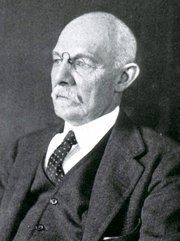
William S. Halsted, MD

William S. Halsted, MD
(1852 – 1922)

American anatomist, teacher, and surgeon, William Stewart Halsted was born in New York City, USA to a wealthy family of English origin. His father was involved in charitable work and Governor and trustee to a city hospital. Not a brilliant student initially, Halsted took an undergraduate in Liberal Arts in Yale, CT., after which he entered the Medical College of Physicians at the Columbia College, where he excelled.

As a second-year medical student Halsted applied and obtained a position in surgery at a local hospital. In here he learned about Lister’s antiseptic technique and became an adamant proponent of it to reduce infection. In 1877 Halsted obtained his MD. After a short time as House Physician at the New York Hospital, Halsted traveled to Europe to further his education studying for two years at the Universities of Vienna, Leipzig, and W?rzburg.

Besides being at the forefront of surgical and antiseptic techniques (introducing the use of rubber gloves in surgery), Halsted was extremely concerned with the way medical students were taught in the US. He pioneered bedside clinical round discussions with the medical students after two years of basic sciences studies. Halsted developed the idea of a patient chart; he also developed the residency program for medical students in use today.

Halsted is probably the most influential researcher and surgeon at the turn of the century. He dedicated time to the study of intestinal anastomoses and the use of silk as a suture material. His experimental work in 1887 proved that the inclusion of the submucosa layer in an anastomosis was mandatory, as well that a single layered anastomosis was enough to attain closure. Perhaps Halsted’s most important contribution was the application and use of the scientific method to surgical questions. Halsted’s principles, also known as  "Halsted's Rules of Surgery", set the standards used today in surgical suturing and surgical stapling.

He also pioneered the development and surgical techniques for radical mastectomy as a treatment for breast cancer.

As a side effect of this studied in anesthesia and the use of cocaine for anesthesia, Halsted became addicted to this substance, a problem that followed him through the years. Without impairing his capacity as a researcher and a surgeon, Halsted eventually recovered. He died in Baltimore in 1922 as a complication to surgery.

Sources:
1. Dubay, A. D., & Franz, G. M. (2003). Acute Wound Healing: The Biology of Acute Wound Failure. Surg Clin NA, 83, 463-481.
2. Halsted, W. S. (1887). Circular Suture of the Intestine - An Experimental Study. Am J Med Sci, 436-461.
3. “William Stewart Halsted: his life and contributions to surgery” Osborne, P. Lancet Oncol 2007; 8: 256–65
4. “William Stewart Halsted: Surgical pioneer” Burress, P Endoc Today (2010), 8: (2) 22
5. “William Stewart Halsted (1852–1922) Neurological stamp” Haas, LF J Neurol Neurosurg Psych 2000;69:641
Original image courtesy of "Images from the History of Medicine" at  www.nih.gov


 "Clinical Anatomy Associates, Inc., and the contributors of "Medical Terminology Daily" wish to thank all individuals who donate their bodies and tissues for the advancement of education and research”.

Click here for more information


bookplateink.com


This article is part of the series "A Moment in History" where we honor those who have contributed to the growth of medical knowledge in the areas of anatomy, medicine, surgery, and medical research.
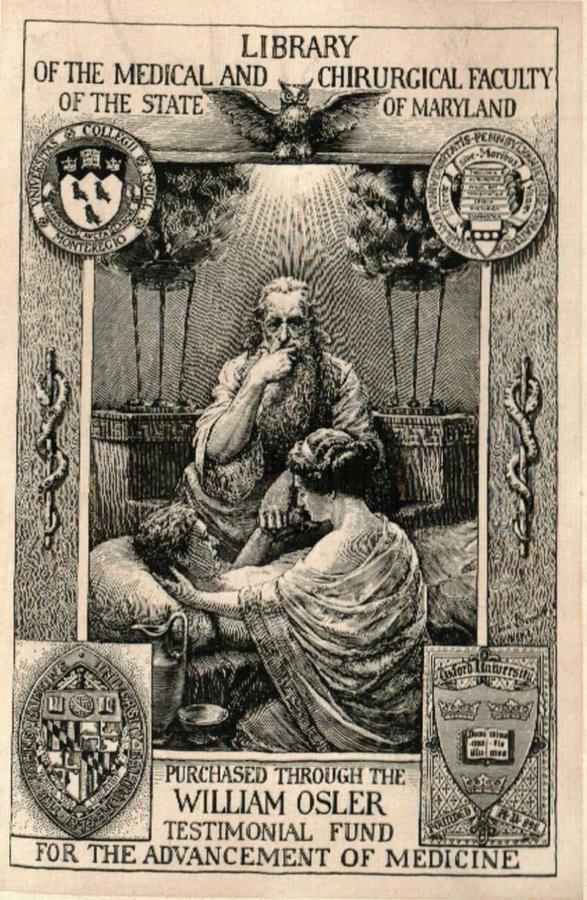
Osler MedChi Ex-Libris

For centuries, book owners and collectors have used bookplates to identify their books and their collections, a tradition that seems to be falling in disuse. Not me, I have one that you can see here.

Bookplates (also known as Ex-Libris) can be a tantalizing study, and finding an interesting one is part of what makes an old book a journey of discovery. Every detail in an old book is important. Who owned it? What is their story? Did they leave personal notes within the pages of the books? I have found prescriptions, personal notes, medical shopping lists, and in some cases corrections to the book itself! One of the most interesting cases of this is Vesalius' Annotated Fabrica!

Bookplates are very personal. In many cases, they depict the coat of arms of the owner’s family, sometimes a motto that drove the book’s owner, the book owner's hobbies, and in some cases a humorous jab at something.

While researching my series of articles on Dr. Ephraim McDowell, I ordered the book “EPHRAIM MCDOWELL, FATHER OF OVARIOTOMY AND FOUNDER OF ABDOMINAL SURGERY. With an Appendix on JANE TODD CRAWFORD”. By AUGUST SCHACHNER, M.D. Cloth, 8vo.A p. 33I. Philadelphia, J. B. Lippincott CO., I921. A great book, I finished reading it overnight!. Dr. McDowell has also been featured in this blog in the series "A Moment in History"

What interested me was the bookplate on the book frontis, a picture of which I placed in this article. It is from the Library of the Medical and Chirurgical faculty of the State of Maryland, and has a legend that states "Purchased through the William Osler Testimonial fund for the advancement of Medicine”. It depicts a physician (probably Hippocrates) taking the pulse of a patient.

Further research indicated that this bookplate was created to honor Sir William Osler by the Maryland State Medical Society and that Dr. Osler’s books never had personal bookplates. MedChi (Maryland State Medical Society) commissioned this plate that depicts the four seals of the universities with which Osler was affiliated: McGill in Montreal, University of Pennsylvania in Philadelphia, Johns Hopkins in Baltimore and Oxford in England. The images are flanked by two rods of Asclepius.This Ex-Libris was designed and drawn by Max Brödel (1870 – 1941) a famous medical illustrator who worked at the Johns Hopkins School of Medicine in Baltimore and illustrated for Harvey Cushing, William Halsted, Howard Kelly, and other notable clinicians. Brödel was a personal friend of Osler. The bookplate was such a hit that doctors from all over the country requested copies of it, which the librarian at the time Ms. Marcia Crocker Noyes,  sent but with the request of receiving the requestor’s own bookplate. You can see all of them in the attached links in the "Sources" section. Interestingly, Ms. Marcia Crocker Noyes has been suspected of still haunting the library where she worked!!

An old book is important not only because of its content, but also because of its provenance. You know where you are going to start reading it, but you never know where are you going to end in researching it. Should you want to have your own bookplate, you can order them from BookPlateInk. On a personal note, develop your own bookplate. It's your legacy. If you want to see my Ex-Libris, it is in my library catalog page. Dr. Miranda.

Sources:
1. Ex Libris: The Bookplate Collection, Part I MedChi
2. Happy Birthday, Sir William! MedChi
3. The bookplate that never was McGill University (PDF)
4. The Osler Library of the History of Medicine: McGill's Medical Memory. Lyons C Mcgill J Med. 2011 Jun; 13(1): 90.
5. The MedChi Collection of Bookplates

6. Max Brödel & MedChi